Trouble Maker: The Playful Display Font for Creative Projects
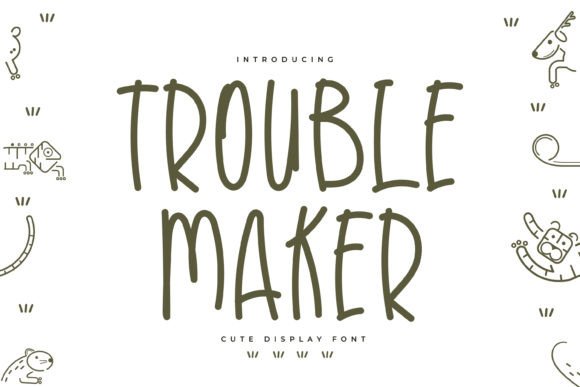
There is a distinct moment in the design process when a project feels too stiff. You have selected your grid, aligned your elements, and chosen a safe, neutral sans serif font for the body copy. Everything is technically correct, yet it lacks soul. This is often where designers turn to a display typeface that breaks the monotony without sacrificing legibility. Enter Trouble Maker, a playful and cute display font that embodies trendiness and authenticity. It is not just a collection of letters; it is a mood setter, perfectly suited for children’s activities, school projects, and any creative endeavor that demands a touch of whimsy.
Unlike rigid geometric types or overly formal serif fonts, Trouble Maker carries a hand-drawn energy that feels immediate and human. Its irregular strokes and bouncy baseline create a rhythm that draws the eye, making it an excellent choice for headlines that need to pop. For professionals working in brand identity or editorial design, understanding how to leverage such a distinctive typeface can elevate a concept from generic to memorable.
Visual Personality and Design Characteristics
To understand why Trouble Maker works, we must look at its anatomy. It sits comfortably in the category of a handwritten font, but with the polish of a premium font. The characters are rounded and soft, avoiding sharp angles that might feel aggressive. This softness is crucial when targeting younger audiences or aiming for a friendly, approachable tone. However, it avoids the cloying sweetness that plagues many "cute" fonts by maintaining a certain structural integrity.
The font’s authenticity comes from its subtle imperfections. No two letters are exactly identical in weight or proportion, mimicking the natural variation of human handwriting. This makes it stand out against the sterile precision of digital defaults. When used in modern typography layouts, these quirks add texture. It is not a script font with connecting ligatures, which can sometimes be hard to read at small sizes. Instead, it functions as a standalone display element, ensuring clarity while retaining character.
For designers, this means Trouble Maker is versatile within its niche. It does not try to be everything to everyone. It knows it is a creative font meant for impact, not for long-form body text. Recognizing this limitation is key to using it effectively. It shines in large sizes where its details can be appreciated, such as on posters, book covers, or hero sections of a website.
Strategic Applications Across Media
The utility of Trouble Maker extends far beyond the classroom. While it is indeed the perfect choice for any children activity or school project, its application in professional contexts is equally robust. Consider packaging design for artisanal goods. A brand selling organic honey, handmade cookies, or eco-friendly toys can use this font to signal warmth and craftsmanship. It tells the consumer that there is a human behind the product, fostering trust and emotional connection.
In the realm of social media graphics, attention is the currency. Scrolling users pause for visuals that break the pattern. A quote card or promotional banner using Trouble Maker can stop the scroll more effectively than a standard bold sans-serif. It adds personality to Instagram stories, Pinterest pins, and Facebook headers. For bloggers and content creators, using this font in featured images can help establish a consistent visual language that followers recognize instantly.
Logo design is another area where this font excels, particularly for startups in the education, entertainment, or lifestyle sectors. A tutoring center, a pediatric clinic, or a family-oriented app can benefit from the friendly vibe it projects. However, caution is advised. Because it is a display font, it should be used sparingly in a logo—perhaps for the brand name only—while pairing it with a clean, readable font for taglines or contact information.
Print materials also benefit from its charm. Invitations for birthday parties, baby showers, or community events gain an instant festive air when headings are set in Trouble Maker. It transforms a standard flyer into something that feels special and curated. In web design, it can be used for navigation labels, call-to-action buttons, or section headers, adding a layer of interactivity and fun to the user experience.
Mastering Font Pairing and Readability
The biggest challenge with any distinctive display font is pairing it correctly. Trouble Maker demands a partner that can ground it. Since it is already busy with personality, the accompanying text should be quiet and structured. A neutral sans serif font like Helvetica, Roboto, or Open Sans works beautifully for body copy. These fonts provide a stable foundation that allows Trouble Maker to shine without competing for attention.
Avoid pairing it with other decorative fonts. Using a script font alongside Trouble Maker creates visual noise and reduces readability. The goal is contrast, not competition. Think of Trouble Maker as the accent color in a room; you do not paint every wall in bright yellow. Similarly, use it for headlines, subheads, or short pull quotes, but rely on simpler typefaces for paragraphs.
Readability is another critical factor. While Trouble Maker is clear at larger sizes, it may become illegible if scaled down too far. Always test your designs at actual size. If you are designing a brochure, print a proof. If it is for web, view it on mobile devices. Ensure that the unique shapes of the letters do not merge or become confusing when viewed quickly. Good visual hierarchy relies on the viewer’s ability to distinguish between important information and supporting details. Trouble Maker should always signal importance.
Evaluating Fit and Licensing Considerations
Before integrating Trouble Maker into your design assets, evaluate whether it aligns with the project’s core message. If the brand voice is serious, corporate, or luxury-oriented, this font may send the wrong signal. It conveys approachability and fun, not exclusivity or authority. Knowing when not to use a font is as important as knowing when to use it.
For professionals, licensing is non-negotiable. Ensure you have the appropriate commercial font license if the project is for a client or a product you intend to sell. Many free fonts are for personal use only, and using them commercially can lead to legal issues. Investing in a proper license supports the type designer and ensures you have the rights to use the font across various media, from print to digital ads.
Ultimately, Trouble Maker is a tool for storytelling. It helps bridge the gap between a brand and its audience by injecting humanity into digital and print spaces. Whether you are a marketer crafting a campaign for a new toy line, a teacher creating engaging worksheets, or a blogger looking to refresh your site’s aesthetic, this font offers a reliable way to add charm. By respecting its strengths and pairing it wisely, you can create designs that are not only visually appealing but also emotionally resonant.
Remember, great design is about communication. Trouble Maker communicates joy, creativity, and warmth. Use it to invite your audience in, make them smile, and keep them engaged. In a world saturated with generic templates, a well-chosen display font can be the difference between being ignored and being remembered.