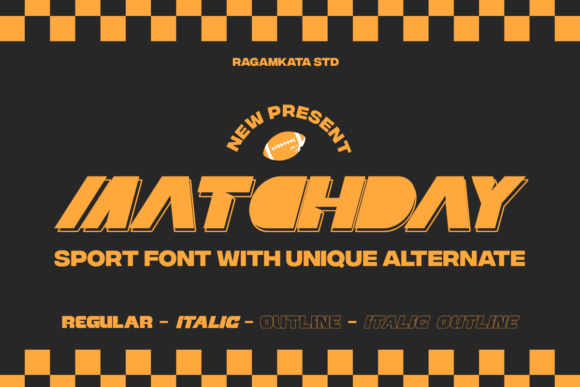
Matchday: A Versatile Sports Typeface for Modern Design
In the realm of graphic design, typography serves as the visual voice of a brand. For industries rooted in motion, competition, and energy—such as sports, fitness, and active lifestyle sectors—the choice of typeface is critical. Matchday emerges as a specialized solution in this niche, offering a sports-inspired font family that balances the raw power of athletic aesthetics with the refinement of classic design principles. This article evaluates the characteristics, applications, and strategic considerations of using Matchday in professional and personal projects.
Understanding the Design Philosophy
Matchday is not merely a bold, blocky display font; it is a carefully constructed typeface that integrates the speed and dynamism of modern sports with elegant structural details. The design philosophy behind Matchday focuses on readability without sacrificing impact. Its smooth curves and clear ligatures ensure that even at larger sizes, the text remains legible and visually cohesive. This balance is essential for designers who need to convey excitement while maintaining a level of sophistication that appeals to broader audiences.
The font family includes four distinct styles: Regular, Italic, Outline, and Outline Italic. This variety allows for hierarchical typography within a single project. For instance, a designer might use the Regular weight for primary headlines and the Outline variant for secondary elements or background textures, creating depth and visual interest without introducing conflicting typefaces.
Key Features and Functional Benefits
One of the most significant advantages of Matchday is its inclusion of unique alternate characters. In standard typography, alternates are often an afterthought, but in Matchday, they are central to its creative potential. These alternates allow designers to customize logos and headlines, ensuring that a brand’s identity feels unique rather than generic. This feature is particularly valuable for studios and creative agencies tasked with developing distinct visual identities for clients in crowded markets.
Furthermore, the font’s modern aesthetics contribute to its versatility. While many sports fonts are limited to aggressive, high-impact contexts, Matchday’s elegance allows it to cross over into more refined applications. It is suitable for:
- Sports Headlines and Editorial Layouts: The clarity of the letterforms makes it ideal for magazine covers and article headers where immediate recognition is key.
- Branding and Logos: The unique ligatures and alternates provide the customization needed for memorable logo design.
- Product Packaging: The clean lines work well on physical products, from supplement containers to athletic apparel tags.
- Event Invitations and Posters: The dynamic presence of the Italic styles adds a sense of movement and urgency appropriate for event promotion.
Evaluating Fit: When to Choose Matchday
Selecting the right typeface requires aligning the font’s personality with the project’s goals. Matchday is a strong fit for projects that require a contemporary touch with an underlying sense of authority and energy. It is particularly effective for corporate entities in the sports industry that wish to appear professional yet approachable. For example, a fitness app interface or a corporate annual report for a sports management firm could benefit from Matchday’s ability to look both powerful and attractive.
Creative agencies will find Matchday useful for client presentations where the theme involves performance, speed, or achievement. The font’s ability to convey motion through its italicized forms makes it a natural choice for campaigns centered around progress and forward momentum. Additionally, because it supports various weights and styles, it can handle complex layouts that require typographic hierarchy without needing to pair multiple different font families.
Tradeoffs and Considerations
While Matchday offers significant benefits, it is important to consider its limitations. As a display-oriented typeface with specific stylistic quirks, it may not be suitable for long-form body text. The unique shapes and alternates that make it striking in headlines can become distracting or difficult to read in dense paragraphs. Designers should reserve Matchday for titles, subheadings, logos, and short bursts of text, pairing it with a neutral sans-serif or serif font for extended reading material.
Another consideration is the context of use. While Matchday blends elegance with sports aesthetics, it is still fundamentally a thematic font. Using it for industries unrelated to energy, movement, or competition—such as legal services or traditional finance—might create a tonal mismatch. Designers must evaluate whether the "dynamic presence" of the font aligns with the brand’s core values. If a brand aims for understated minimalism or traditional conservatism, a more conventional typeface might be a safer choice.
Comparison with Alternatives
When evaluating Matchday against other sports-themed fonts, several factors come into play. Many free or low-cost sports fonts rely heavily on extreme boldness and distressed textures, which can limit their usability to very specific, gritty contexts. Matchday distinguishes itself through its smooth curves and refined finish. This makes it more versatile than rugged, stencil-style fonts, allowing it to function in upscale environments such as premium sportswear branding or high-end fitness studio signage.
However, if a project requires a purely utilitarian, invisible typeface for data-heavy interfaces, a standard geometric sans-serif like Helvetica or Roboto may be more appropriate. Matchday is designed to be seen and noticed; it is a decorative element as much as a functional one. Designers seeking maximum neutrality should look elsewhere, but those seeking character and thematic resonance will find Matchday to be a compelling option.
Practical Decision-Making Insights
For individuals and teams deciding whether to incorporate Matchday into their toolkit, the following questions can help guide the decision:
- Does the project require a sense of motion or energy? If yes, Matchday’s italic and dynamic structures are advantageous.
- Is customization important? If the project involves logo design or unique branding, the alternate characters offer significant value.
- What is the medium? For print materials like posters and packaging, Matchday’s clarity and style shine. For digital body text, consider it only for headings.
- Who is the audience? If the target demographic appreciates modern, sleek design with a sporty edge, Matchday aligns well with their expectations.
Ultimately, Matchday represents a thoughtful intersection of form and function. It provides the visual weight required for sports-related content while maintaining the elegance necessary for broader commercial appeal. By understanding its strengths in headline usage and branding, and acknowledging its limitations in long-form text, designers can leverage Matchday to create impactful, contemporary designs that resonate with their intended audience.
Whether for a personal project, a corporate rebrand, or a creative agency’s latest campaign, Matchday offers a reliable and stylish typographic foundation. Its ability to adapt across various media—from digital screens to physical packaging—makes it a versatile asset for any designer looking to infuse their work with a sense of power and modern sophistication.